

Alphabet of Quadrupeds, elephant spread
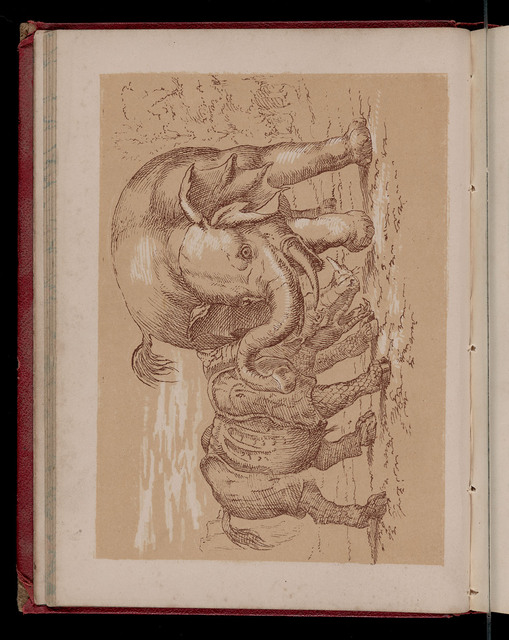
Full description
As Henry Cole explains in the book's contents and preface, the letter E “Elephant” is illustrated by a sepia-toned engraving copied after Tempest's etchings at the British Museum, in which a tusked elephant nuzzles a rather scaley looking rhinoceros. Cole is more concerned with faithfulness to art at the British Museum, where he instructs readers to hunt for these pictures, than with faithfulness to scientific knowledge of animals' appearances. The text on two pages that follow the illustration addresses the reader, directing their attention to the image in the book. This chatty address to child users in the second person is common in primers for younger readers that combine an illustration with brief sentences about commonplace objects. Typically the image depicts an object that children would see around the home or on walks, so that chatty language models conversational learning while providing a reading lesson. The miniature books produced by John Marshall provide another example of conversational reading instruction. In Cole's case, the elephant only becomes an everyday object when families walk around the British Museum, “gathering” images by drawing them. This activity resembles the collection practices of child characters in natural history books about collection, such as The India Cabinet Opened by Lucy Wilson.
- typeImage
- created on
- file formatjpg
- file size317 KB
- container titleFelix Summerly [Henry Cole], An Alphabet of Quadrupeds, Partly Selected from the Works of Old masters, and Partly Drawn from Nature (London: Joseph Cundall, 1844).
- creditCotsen Children’s Library, Courtesy of Princeton University Library
- rightspublic domain
We use cookies to analyze our traffic. Please decide if you are willing to accept cookies from our website. You can change this setting anytime in Privacy Settings.