

E. W. Payne, Village Science
Full description
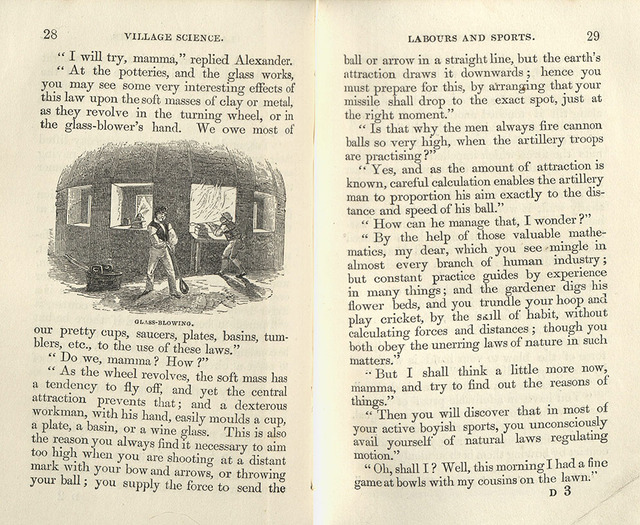
This spread from Village Science includes an illustration of “Glass -Blowing,” which shows a man pulling heated glass from a flaming furnace while another blows glass. The surrounding dialog between mother and child covers pottery, military cannons, and other practical uses for science, justifying why Alexander should learn this practical subject. Mother compares Alexander’s play to physical labor, which a person can perform according to mechanical laws without understanding how those laws operate: “the gardener digs his flower beds, and you trundle your hoop and play cricket, by the skill of habit, without calculating forces and distances; though you both obey the unerring laws of nature in such matters.” Unlike a gardener, however, Alexander will come to understand these laws, distinguishing himself from the laborers he resembles by his ability to think: “But I shall think a little more now, mamma, and try to find out the reasons of things.” One purpose of learning mechanical philosophy, then, is to enable Alexander to leave behind his physical existence as a child and assume, through this self-awareness of movement, a higher social station above those who supposedly lack this knowledge.
- typeImage
- created on
- file formatjpg
- file size286 KB
- container titleE. W. Payne, Village Science; or, The Laws of Nature Explained (London: Religious Tract Society, 1851).
- creditCourtesy of the Baldwin Library of Historical Children’s Literature, George A. Smathers Libraries, University of Florida
- rightsPublic Domain
We use cookies to analyze our traffic. Please decide if you are willing to accept cookies from our website. You can change this setting anytime in Privacy Settings.