



Inventing the Boston Game

Football, Soccer, and the Origins of a National Myth

User Avatar
Kevin Tallec Marston
User Avatar
Mike Cronin

On Boston Common stands a monument dedicated to the Oneida Football Club. It honors the site where, in the 1860s, sixteen boys played what was then called the “Boston game”—an early version of football in the United States. The boys were largely the sons of upper-class Boston Brahmins, and they lived through the transformative periods of the Civil War, Reconstruction, and the Gilded Age. Later as they grew old, in the 1920s, a handful of them orchestrated a series of commemorative events about their boyhood game. Benefitting from elite networks developed through the city’s social and educational institutions, including Harvard University, they donated artifacts (such as an oddly shaped, battered black ball) to museums, deposited self-penned histories into libraries and archives, and erected bronze and stone memorials, all to elevate themselves as the inventors of American football (and later, by extension, soccer). But was this origin story of what, by then, had become one of America’s favorite games as straightforward as they made it seem or a myth-making hoax?

In Inventing the Boston Game, Kevin Tallec Marston and Mike Cronin investigate the history of the Oneida Football Club and reveal what really happened. In a compelling, well told narrative that is informed by sports history, Boston history, and the study of memory, they posit that these men engaged in self-memorialization to reinforce their elite cultural status during a period of tremendous social and economic change, and particularly increased immigration. This exploration of the Club’s history provides fascinating insight into how and why origin stories are created in the first place.

Cover design by adam b. bohannon
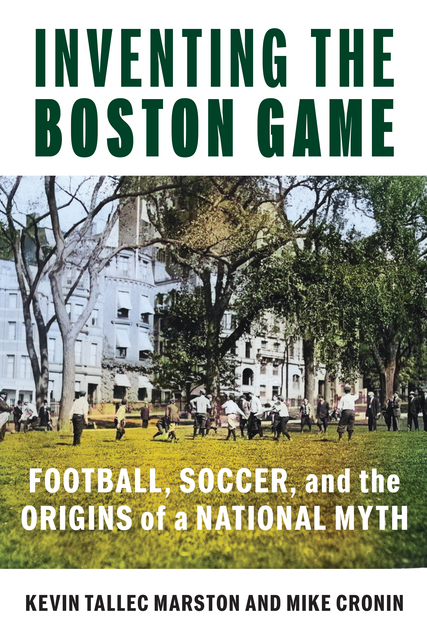
Cover photo by Lewis Wickes Hine, Amateur Football on the Boston Common. Location: Boston, Massachusetts. Boston Massachusetts United States, 1909. October. Courtesy, Library of Congress.

Contents

Illustrations
Preface
Acknowledgments
The Oneida Team Members

Introduction: The 1927 Luncheon

PART I: THE ONEIDAS AND BOSTON

1: 1863: The Match
2: School Years: A Classroom, a City, and a War
3: Games: Spaces, Clubs, and Organizing Play
4: The Crimson: Harvard and Football
5: Brahmin Networks: Families, Professions, and High Society

PART II: FROM MEMORY TO MONUMENT

6: Dinner Guests: Books, Memories, and the Origins of Sport
7: The Boy in Bronze: Schools, Anniversaries, and the Birth of a Myth
8: Monument Men: Deaths, Rivals, and Making a City Legend

PART III: THE STEAL AND THE HOAX

9: The Soccer Grab: Surprise Legacies, Halls of Fame, and Refurbishing a Usable Past
10: Postmatch Analysis: Friendly Tactics, Mischief, and Gammon, or a Hoax?
11: Conclusion: Boys Will Be Boys
Epilogue

Notes
Index

Supplemental Texts

Uncategorized

Metadata

  • publisher
    University of Massachusetts Press
  • publisher place
    Amherst & Boston