

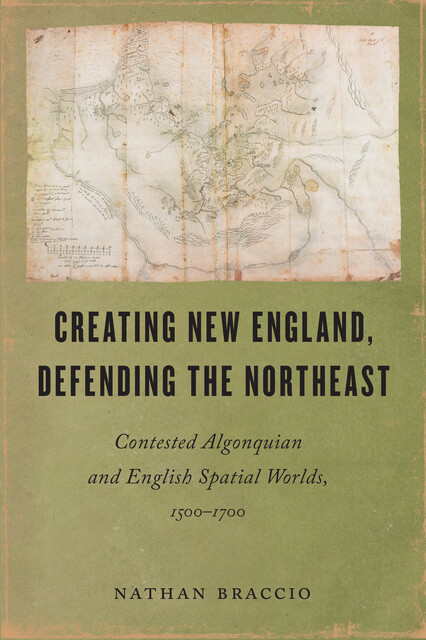
Creating New England, Defending the Northeast

Contested Algonquian and English Spatial Worlds, 1500–1700

User Avatar
Nathan Braccio

Examining maps and placemaking during negotiations between Indigenous people and colonial settlers.

Between 1500 and 1700, Indigenous and English mapmakers across the North Atlantic depicted present-day New England in markedly distinct ways, highlighting how differently their communities understood the landscape. While English cartographers relied on new mathematics and other developing scientific knowledge from Europe, as well as an overhead perspective of the world, Algonquian mapmakers drew on deep knowledge of the landscape, derived from their communities’ long history upon it. Nathan Braccio refers to this phenomenon as “parallel landscapes.”

Creating New England, Defending the Northeast asserts that Algonquian knowledge of the landscape represented a powerful and persistent alternative to English surveying and mapmaking in the Northeast. When English colonists and explorers recognized the unsuitability of their techniques for understanding New England’s unfamiliar landscape, they attempted to appropriate Indigenous knowledge and maps. Algonquian sachems used this as an opportunity to control and benefit from their new English neighbors. Later, as the English became insecure in their dependence on Indigenous people, they began to remake and mark the landscape. Algonquians adapted, maintaining control of important spatial knowledge, even in a place no longer entirely of their making. This story complicates narratives of conquest and highlights the Indigenous spatial knowledge too often overlooked.

Cover design by adam b. bohannon Cover art by John Winthrop (cartographer), A chart of Massachusetts Bay, 1634. Courtesy Boston Public Library.

Contents

List of Illustrations

Acknowledgments

Abbreviations

Introduction

Chapter One
The Describers of England Origins of Colonial Conceptions of Space

Chapter Two
Profitable Land English Exploration in the Northeast, 1520–1592

Chapter Three
Creating the Northeast The Spatial Cultures of Northeastern Algonquian Peoples

Chapter Four
Expert Knowledge English Appropriation of Algonquian Expertise, 1600–1620

Chapter Five
Imagining a Hybrid “New England” Indigenous Influences on English Ideas of the Land, 1620–1635

Chapter Six
The Rise of Surveyors and the Creation of a New, English Spatial Culture, 1635–1660

Chapter Seven
New Algonquian Knowledge and the Indigenization of English Maps and Borders, 1660–1689

Epilogue

Notes

Index

Several maps referenced in the text are available at high-resolution online at https://umpressopen.library.umass.edu/projects /creating-new-england-defending-the-northeast

Metadata

  • rights
    Copyright © 2026 by University of Massachusetts Press

    Subject
    HISTORY / United States/State & Local/New England (CT, MA, ME, NH, RI, VT)
    HISTORY / Indigenous/Contact, European Invasion & Exploration
    HISTORY / Indigenous/Colonial History & Interaction with Nations, Tribes, Bands & Communities

    Credit Line:
    Courtesy of the Massachusetts Archives

    Citation:
    Massachusetts Archives Collection, 45:387, "Laidout to John Martin of Chelmsford...", 10 May, 1665. SC1/series 45X. Massachusetts Archives. Boston, Massachusetts. Third Series Maps Collection. 37:19. "Plan Surveyed by Richard Clements of Tract at Long Creek in Falmouth, ME, Granted David Phyppen", 2 December, 1687. SC1/series 50. Massachusetts Archives. Boston, Massachusetts. Third Series Maps Collection. 3:3. "Two Plans of Land Near Chelsea (Rumney Marsh) Granted Lieut. Col. Nicholas Paige and wife", 18 January, 1687. SC1/ series 50. Massachusetts Archives. Boston, Massachusetts.
    Permission is hereby granted to publish in whole or in part the documents described above. It is understood that these are public records for which no copyright may be claimed and that the full citation is included above.
  • isbn
    978-1-62534-913-2 (paper)
    978-1-62534-914-9 (hardcover)
    978-1-68575-194-4 (ePub)
    978-1-68575-195-1 (webPDF)
  • publisher
    University of Massachusetts Press
  • publisher place
    Amherst & Boston
  • doi